Posting Workers to Germany for Foreign Construction Companies
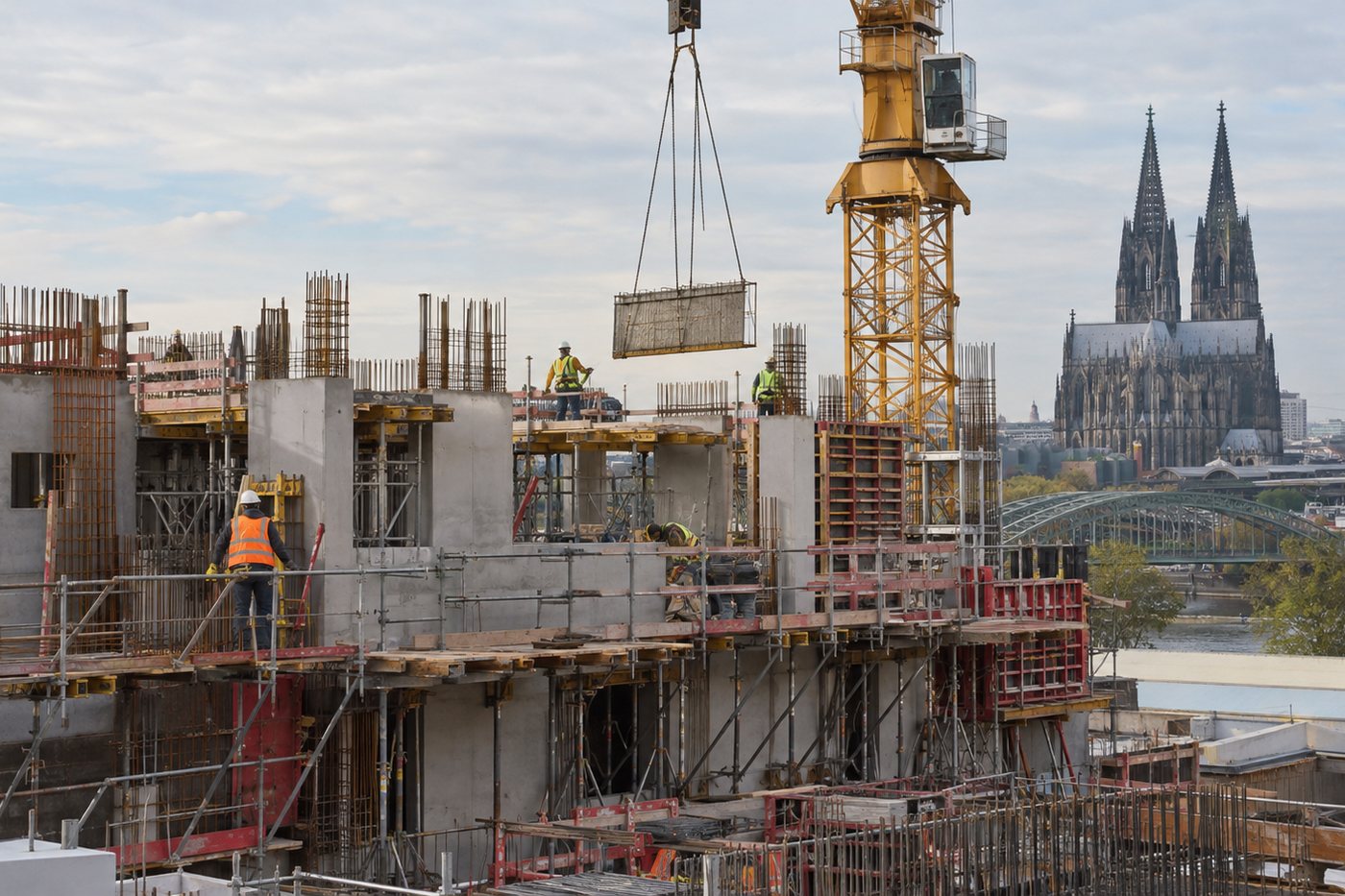
A1 certificate, work permits, minimum wage, notification to customs, SOKA-BAU, working time records, FKS inspections, taxes and main contractor liability: what to consider before and during an assignment on a German construction site.
Guide as PDF
Posting Workers to Germany for Foreign Construction Companies · 14 pages · As of October 2026
Overview
A company based abroad that sends workers to a German construction site remains their employer, but must comply with German minimum working conditions from day one, notify the posting in advance and keep documents available in Germany. Social security remains in the home country if a valid A1 certificate or a posting certificate under a social security agreement is in place.
Compliance is monitored by the Financial Control of Undeclared Work (Finanzkontrolle Schwarzarbeit, FKS) of German customs and, in the construction sector, also by SOKA-BAU. Most fines result not from wage dumping but from formal errors: missing notification, incomplete working time records, documents only in the language of the home country or not available on site.
| Area | What applies | Legal basis |
|---|---|---|
| Employment contract | Law of the home country, but at least the German core working conditions | Secs. 2, 5 AEntG, Art. 9 Rome I Regulation |
| Minimum wage | German minimum wage or higher sector-specific minimum wage | MiLoG, AEntG |
| Social security | Home country, as long as an A1 or posting certificate is in place | Art. 12 Reg. (EC) 883/2004, SSAs, Sec. 5 SGB IV |
| Construction holiday fund | Participation in the SOKA-BAU holiday fund procedure | Sec. 5 AEntG, VTV, SokaSiG |
| Notification | Electronically to customs before work starts | Sec. 18 AEntG, Sec. 16 MiLoG |
| Records | Daily working time; documents in German, kept in Germany | Sec. 19 AEntG, Sec. 17 MiLoG |
| Taxes | Construction withholding tax, VAT, where applicable permanent establishment and wage tax | Secs. 48 et seq. EStG, Sec. 13b UStG, DTTs |
A1 Certificate
The A1 certificate proves that a worker remains insured in the home country during the posting. Without it, the FKS may assume German social security liability and claim contributions; the employer then effectively pays twice.
Requirements for a posting from the EU, the EEA or Switzerland
Art. 12 Reg. (EC) 883/2004, Art. 14 Reg. (EC) 987/2009:
- The posting is expected to last no more than 24 months.
- Immediately beforehand, the worker was insured in the home country for at least one month.
- The worker does not replace another posted worker.
- The employment relationship with the posting employer continues; the employer pays the wages and has the right to give instructions.
- The employer normally carries out substantial activities in the home country. As a guideline, at least 25% of turnover should be generated there. Letterbox companies do not receive an A1.
Application and carrying the certificate
The A1 is applied for before the posting begins at the competent social security institution of the home country. It should be available on site as an original or copy and also be kept with the documents in Germany. Retroactive issue is possible, but does not prevent problems in an inspection carried out before it was issued.
Binding effect
A valid A1 is binding on German authorities and courts. Only in cases of fraud can it be disregarded, following a procedure with the issuing institution (CJEU, judgment of 6 February 2018, C-359/16, Altun).
Third-country nationals employed by an EU employer
If a company from an EU Member State employs third-country nationals, for example from Serbia or Ukraine, who reside lawfully in that state, coordination also applies (Reg. (EU) 1231/2010, not in relation to Denmark); an A1 can then be issued. For the right of residence in Germany, see the next section.
Employers from outside the EU
Germany has concluded bilateral social security agreements with numerous other states; of practical importance for construction are, for example, those with Serbia, Bosnia and Herzegovina, Montenegro, North Macedonia, Kosovo and Türkiye. Instead of the A1, a posting certificate under the respective agreement is issued. Duration, form and insurance branches covered differ between agreements; branches not covered may be subject to German insurance. For the United Kingdom, the Protocol on Social Security Coordination in the EU–UK Trade and Cooperation Agreement has applied since 2021, allowing postings with a certificate for up to 24 months. Where no agreement exists, foreign insurance continues only if the requirements of “Einstrahlung” (Sec. 5 SGB IV) are met: the posting must be limited in time in advance, and the employment relationship with the foreign employer must continue. Otherwise, German social security liability applies from day one.
Work Permits for Third-Country Nationals
Nationals of the EU, the EEA and Switzerland do not need a work permit for a posting. For workers who are third-country nationals, the route depends on where the employer is based.
| Employer | Worker | Route | Note |
|---|---|---|---|
| Based in the EU, EEA or Switzerland | Third-country national with residence permit and regular employment in the state of establishment | Posting under the freedom to provide services, without approval of the Federal Employment Agency (Sec. 21 BeschV, “Vander Elst visa”) | For longer assignments, visa from the German mission in the state of establishment; the residence permit there must cover the assignment period |
| Based in a state with a contract-for-work agreement (e.g. Serbia, Bosnia and Herzegovina, North Macedonia, Türkiye) | Own employees | Contract-for-work procedure under a bilateral agreement (Sec. 29 BeschV) | Annual quotas, approval of the Federal Employment Agency, long lead time for applications |
| Based in any other third country (e.g. United Kingdom, Ukraine) | Own employees | No general access for construction services; approval of the Federal Employment Agency only in narrowly defined exceptions (e.g. installation of delivered equipment, Sec. 19(2) BeschV) | Check case by case before accepting an order; a German subsidiary is often the viable route |
| German subsidiary | Nationals of Albania, Bosnia and Herzegovina, Kosovo, Montenegro, North Macedonia, Serbia; skilled workers from all third countries | Direct hiring under the Western Balkans Regulation (Sec. 26(2) BeschV) or as a skilled worker (Secs. 18a, 18b AufenthG) | Tied to the job; Western Balkans Regulation with annual quota, skilled workers with recognised qualification; employment contract under German law and German social security |
Practical points
- Third-country nationals who are only hired for the assignment in Germany generally do not meet the requirements for a Vander Elst posting. The FKS checks how long they have been employed by the employer.
- For companies from third countries wishing to work in Germany on a permanent basis, a German GmbH hiring under the Western Balkans Regulation or skilled immigration rules is often easier to plan than the quota-based contract-for-work procedure. See our guide on company formation.
- Employing workers without the required residence title is an administrative offence for the employer with a fine of up to €500,000 (Sec. 404(2) no. 3 SGB III) and, in serious cases, a criminal offence (Secs. 10, 11 SchwarzArbG).
Minimum Working Conditions
From the first working day in Germany, the German core working conditions apply to posted workers, even if the employment contract is governed by foreign law (Sec. 2 AEntG). More favourable terms of the home contract remain in force.
Minimum wage 2026
Since 1 January 2026, the statutory minimum wage has been €13.90 gross per hour; on 1 January 2027 it will rise to €14.60. Since 2022, there has no longer been a separate sector-specific minimum wage for the main construction trade; the statutory minimum wage applies there. Higher sector-specific minimum wages apply in several finishing trades:
| Trade | Minimum wage per hour 2026 | Already set for 2027 |
|---|---|---|
| Roofing, skilled workers | €16.60 | €17.10 |
| Painting and varnishing, journeymen | €16.13 (since 1 July 2026) | – |
| Roofing, unskilled workers | €14.96 | – |
| Electrical trades | €14.93 | €15.49 |
| Scaffolding | €14.35 | €14.90 |
| Other construction work, unskilled painters | €13.90 (statutory minimum wage) | €14.60 |
Source: German Customs, overview of sector-specific minimum wages, BMAS, sector-specific minimum wages. The decisive minimum wage is that of the trade to which the predominant activity of the business belongs.
Posting allowances
Allowances only count towards the minimum wage if they are not paid as reimbursement of travel, board or accommodation costs (Sec. 2b AEntG). If the contract does not clearly state what an allowance is paid for, it is deemed reimbursement of costs and is not counted. Deductions from wages for accommodation, tools or work clothing must not reduce pay below the minimum wage.
Other mandatory conditions (Sec. 2 AEntG)
- Maximum working hours under the Working Hours Act: 8 hours per working day, up to 10 hours with compensation, 11-hour rest period, Sunday and public holiday work only by way of exception,
- paid minimum annual leave; in construction through the SOKA-BAU holiday fund procedure,
- health and safety and hygiene at the workplace,
- requirements for accommodation provided by the employer (Workplace Ordinance),
- equal treatment of men and women and protection of pregnant women and young people.
Notification Before Work Starts
Every posting must be notified electronically to customs before work begins (Sec. 16 MiLoG, Sec. 18 AEntG). Notification is made via the Minimum Wage Notification Portal at www.meldeportal-mindestlohn.de; notification by fax is no longer possible. The portal is available in German, English and French. After submission, the employer receives a confirmation of receipt with a notification ID; it belongs in the site documents.
Content of the notification
- surname, first name and date of birth of each worker,
- start and expected duration of employment,
- place of employment; for construction sites, their address,
- place in Germany where the documents are kept,
- name and address of a responsible person in Germany,
- name and address of an authorised recipient for service in Germany, if different,
- sector in which the workers are deployed.
With the notification, the employer declares that it complies with the German minimum working conditions.
Changes
Additional workers, a new construction site or an extension must be notified without delay. Where construction work takes place at changing locations, a deployment plan covering up to three months can be submitted (Sec. 2 MiLoMeldV).
Exemption for higher salaries
The notification and record-keeping obligations do not apply to workers with a regular monthly salary of more than €4,461 gross, or of more than €2,974 gross if this salary has demonstrably been paid over the last twelve months (Minimum Wage Documentation Ordinance, figures as stated by German Customs). In practice, this exemption rarely applies to construction workers.
Fines
A missing, incorrect or late notification can be fined up to €30,000 per violation (Sec. 21(1), (3) MiLoG).
SOKA-BAU
Foreign construction companies posting manual workers to German construction sites must participate in the SOKA-BAU holiday fund procedure. Only the holiday procedure applies to them; contributions for vocational training and supplementary pensions are not payable by posting companies. The legal basis is the generally binding collective agreement on the social fund procedure in construction (VTV), the Social Fund Procedure Safeguarding Act (SokaSiG) and Sec. 5 AEntG.
Who is affected
The decisive factor is whether the workers deployed in Germany predominantly, i.e. for more than half of their working time, perform construction activities within the meaning of the VTV. For foreign employers, the workers posted to Germany are treated as a separate business; the company’s activities in the home country are irrelevant. For some finishing trades (e.g. roofers, scaffolders, painters), separate social funds or exceptions apply, which must be examined case by case.
Contribution and reimbursement
| Item | Value | Note |
|---|---|---|
| Holiday fund contribution | 14.7% of gross wages in Germany | Since the July 2026 accounting month; previously 15.1% |
| Holiday pay for leave taken during the posting | 14.25% of gross wages | Paid by the employer; SOKA-BAU reimburses it if all reports and contributions are up to date |
| Compensation paid directly to the worker | 12.50% of gross wages | Worker applies personally; German tax ID required |
Source: SOKA-BAU International, employers, SOKA-BAU International, workers.
Obligations step by step
- Registration of the business with SOKA-BAU (posting procedure) before the first posting.
- Monthly report per worker with gross wages, hours worked and construction site in Germany.
- Monthly payment of contributions; arrears block reimbursement.
- Reimbursement application for holiday pay paid.
Typical disputes
SOKA-BAU often assesses contributions retroactively and on the basis of estimates if a business has not registered. The claims are brought before German labour courts, including against companies without a branch in Germany. What then matters is proof of the activities the workers actually performed; activity reports and timesheets should therefore be kept by trade.
Working Time Records and Documents
In construction, the employer must record the start, end and duration of daily working time for each worker no later than the end of the seventh calendar day after the working day, and keep the records for at least two years (Sec. 17(1) MiLoG, Sec. 19(1) AEntG). Breaks must be recorded so that actual working time is identifiable. No particular form is currently prescribed; paper timesheets are permissible if they are complete and countersigned by the worker.
To be kept in Germany, in German
Sec. 17(2) MiLoG, Sec. 19(2) AEntG: for the entire duration of the work, for a maximum of two years, and on request also on site:
- employment contracts or written evidence of the essential working conditions,
- working time records,
- payslips,
- proof of actual payment of wages (bank statements, transfer receipts).
In practice, this also includes the A1 certificates, the confirmation of receipt of the customs notification, the works contract with the German client and proof relating to SOKA-BAU. Translations do not need to be certified, but must be complete in content.
Duty to carry identification
Every worker on a construction site must carry a passport, identity card or equivalent identification document and present it on request; the employer must inform the worker of this in writing and keep a record of the notice (Sec. 2a SchwarzArbG).
Inspections by the Financial Control of Undeclared Work (FKS)
The FKS generally inspects construction sites without prior notice. It may enter premises and business premises during working hours, establish identities, question workers and inspect and copy documents (Secs. 2 to 4 SchwarzArbG). Employers and workers must tolerate the inspection and cooperate (Sec. 5 SchwarzArbG).
Typical procedure
- The officers secure the site and establish the identity of everyone present.
- Workers complete a questionnaire, usually in their native language, on employer, working hours, wages, accommodation and travel.
- The FKS requests the documents on site or subsequently requests them in writing from the employer or the responsible person.
- The workers’ statements are compared with timesheets, payslips and the notification.
- Discrepancies lead to a hearing, administrative fine proceedings or criminal investigation, and possibly back claims by the German Pension Insurance and SOKA-BAU.
Most frequent findings in practice
- Workers state longer working hours than shown on the timesheets.
- Flat-rate or piece-rate wages without hourly records; the hourly minimum wage cannot be verified.
- Deductions for accommodation, travel or meals push wages below the minimum wage.
- A1 certificates are missing, have expired or do not cover the construction site.
- Documents are only available in the language of the home country or only in the home country.
- Sole traders from the home country engaged as subcontractors in fact work under instructions. The FKS treats this as bogus self-employment with consequences under social security and criminal law (Sec. 266a StGB).
Consequences beyond the fine
From a fine of €2,500, the company may be excluded from public contracts (Sec. 19 MiLoG, Sec. 21 AEntG, Sec. 21 SchwarzArbG). The decision is also entered in the Competition Register, which public contracting authorities must consult before every award.
Taxes
In Germany, foreign construction companies are handled for tax purposes by a centrally competent tax office for each home country (Sec. 20a AO in conjunction with the VAT Jurisdiction Ordinance), for example Munich for Austria, Konstanz for Switzerland, Offenburg for France, Kleve for the Netherlands and Nuremberg for Hungary. For states without a specific allocation, the Berlin Neukölln tax office is competent. This tax office is responsible for VAT, construction withholding tax, wage tax and income taxes.
Construction withholding tax and exemption certificate
Business clients must withhold 15% of every payment for construction services and pay it to the tax office if the contractor does not provide a valid exemption certificate (Secs. 48, 48b EStG). Without the certificate, 15% of liquidity is therefore missing until the tax is returned in the refund procedure. The certificate is applied for at the competent tax office; the company must be registered for tax purposes and meet its obligations. It is usually valid for up to three years and should be available before the first order.
VAT
If a company established abroad provides construction services to a German business, the client owes the VAT (reverse charge, Sec. 13b(2) no. 1, (5) UStG). The invoice is issued without German VAT and with the note “Steuerschuldnerschaft des Leistungsempfängers” (reverse charge). If the company works for private customers, it must register in Germany and charge 19% VAT.
Permanent establishment
A construction site becomes a permanent establishment if it exceeds the duration set in the double taxation treaty, 12 months in most treaties (under domestic law as early as 6 months, Sec. 12 sentence 2 no. 8 AO). Several sites of one contract or consecutive contracts in the same project may be aggregated. With a permanent establishment, the profit generated there becomes subject to German corporate income tax and trade tax.
Wage tax of the workers
Without a permanent establishment, wages generally remain taxable in the home state as long as the worker does not stay in Germany for more than 183 days in the relevant period. If the wages are borne by a German permanent establishment or the 183-day limit is exceeded, wage tax must be withheld in Germany from day one. The counting method (calendar year or any twelve-month period) depends on the respective treaty. If there is no double taxation treaty with the worker’s state of residence, wages for work in Germany are in principle taxable here (Sec. 49(1) no. 4 EStG).
Liability of the Main Contractor
German main contractors are liable, irrespective of fault, for certain obligations of their foreign subcontractors. They therefore require extensive proof before awarding contracts and often retain part of the remuneration as security. Those who can provide this proof completely and in German have a real competitive advantage.
| Liability for | Legal basis | Proof required by the main contractor |
|---|---|---|
| Minimum wage or sector-specific minimum wage of the workers of the subcontractor and all further subcontractors | Sec. 14 AEntG, Sec. 13 MiLoG | Minimum wage declaration, payslips and proof of payment on request |
| SOKA-BAU contributions | Sec. 14 AEntG | SOKA-BAU clearance certificate |
| German social security contributions in construction (contract volume from €275,000) | Sec. 28e(3a) SGB IV | A1 or posting certificates; where German insurance applies, clearance certificates or prequalification |
| Statutory accident insurance contributions | Sec. 150(3) SGB VII | Proof of accident insurance |
| Construction withholding tax | Sec. 48a(3) EStG | Valid exemption certificate |
Also customary are the confirmation of receipt of the customs notification, a current commercial or company register extract with translation, and an indemnity in the subcontract.
Checklist Before Site Start and Overview of Fines
Before the first order in Germany
- Tax registration with the competent tax office and exemption certificate under Sec. 48b EStG
- Registration with SOKA-BAU (posting procedure), if construction activity
- Appoint a responsible person and an authorised recipient in Germany
- Adapt employment contracts to German minimum conditions, define allowances clearly
- Introduce an electronic or complete paper system for daily time recording
- Have documents translated into German
Before each posting
- A1 or posting certificate applied for and received for each worker
- For third-country nationals: residence permit in the state of establishment or approval of the Federal Employment Agency and, where applicable, visa checked
- Notification submitted via the Minimum Wage Notification Portal, confirmation filed
- Site folder with all documents held by the foreman
- Workers informed in writing of the duty to carry identification
- Compliance package handed over to the German client
Ongoing
- Timesheets complete no later than seven days
- Wages of at least the minimum wage paid by bank transfer, not in cash
- Monthly reports and payments to SOKA-BAU
- Changes (workers, site, duration) notified to customs without delay
- Days of presence per worker and duration per site recorded for permanent establishment and 183-day rule
Fines and sanctions (maximum amounts per violation)
| Violation | Maximum | Legal basis |
|---|---|---|
| Minimum wage or sector-specific minimum wage not paid or not paid on time | €500,000 | Sec. 21 MiLoG, Sec. 23 AEntG |
| SOKA-BAU contributions not paid | €500,000 | Sec. 23 AEntG |
| Use of a subcontractor who does not pay the minimum wage (with knowledge or negligent ignorance) | €500,000 | Sec. 21 MiLoG, Sec. 23 AEntG |
| Employment of third-country nationals without the required residence title | €500,000 | Sec. 404 SGB III |
| Notification missing, incorrect or late | €30,000 | Sec. 21 MiLoG, Sec. 23 AEntG |
| Working time not recorded or not recorded correctly, documents not kept available | €30,000 | Sec. 21 MiLoG, Sec. 23 AEntG |
| Inspection not tolerated or cooperation refused | €30,000 | Sec. 8 SchwarzArbG |
| Social security contributions withheld (e.g. without a valid A1 or in case of bogus self-employment) | Criminal offence, imprisonment of up to 5 years | Sec. 266a StGB |
In addition to the fine, the economic advantage gained through the violation can be confiscated; the fine may exceed the statutory maximum for this purpose (Sec. 17(4) OWiG).
Support from WYN LEGAL
WYN LEGAL advises foreign construction companies on legal and tax aspects of posting workers to Germany, in German, English, Portuguese and Hungarian. We handle tax registration and the application for the exemption certificate, review employment contracts and subcontracts, set up notification and documentation processes, represent clients before SOKA-BAU, the main customs office and the German Pension Insurance, and defend in administrative fine and criminal proceedings.
Take the complete guide with you
Posting Workers to Germany for Foreign Construction Companies · 14 pages · As of October 2026
This guide provides a general overview of the legal situation as of October 2026. It does not replace advice in an individual case. Laws, minimum wages, contribution rates and administrative practice change constantly; no liability is accepted for accuracy in a specific case.